6 Food & Beverages Quality Leaders on Technology, Transformation, and What's Reshaping the Profession.

In this article
What does the future of food safety and quality look like? 6 leaders from Kraft Heinz, Mars and Barilla identify the 4 shifts moving quality from a compliance function to strategic advantage.
To understand how the role of quality in food manufacturing is evolving in 2026 and beyond, we sat down with senior quality leaders from Kraft Heinz, Mars, Suntory, Barilla, AAK, and the Juran Institute. This is what they had to say.
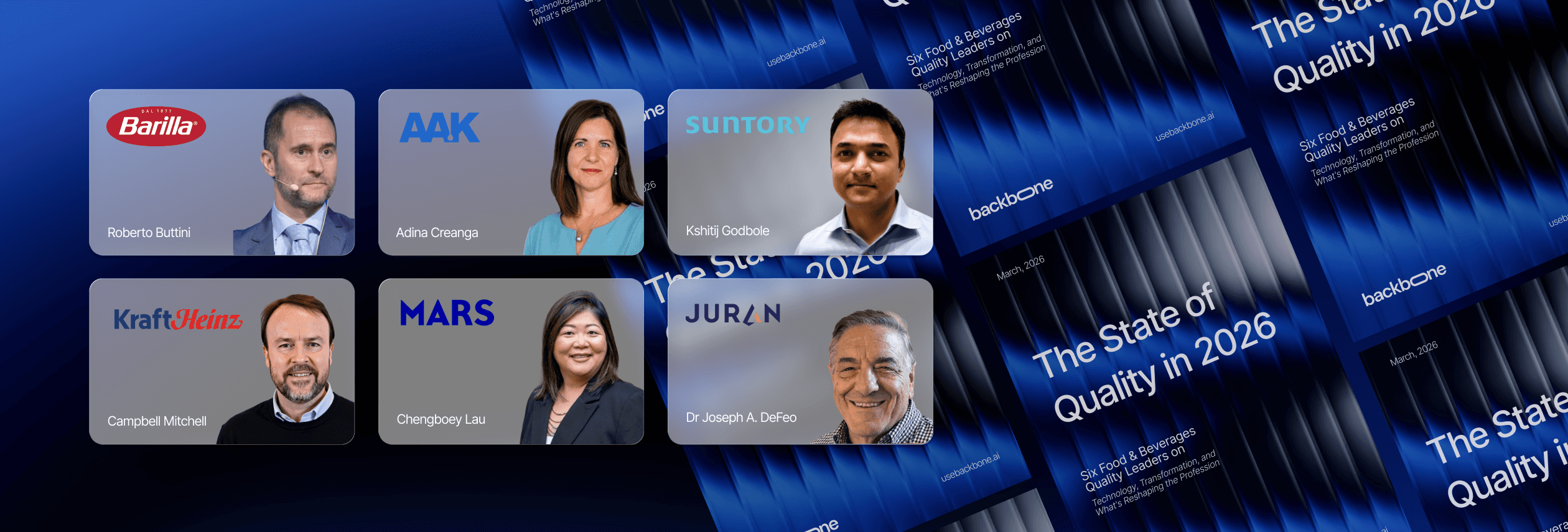
This is the state of quality.
Their perspectives converge on a clear conclusion: the mandate of quality is expanding. Food production systems are becoming faster, more global, and more complex. At the same time, expectations from regulators, customers, and consumers continue to rise.
New technologies are creating opportunities to detect risks earlier and embed quality more deeply across operations. Quality functions are being asked to do more than ensure compliance. They are expected to anticipate risks earlier, enable operational excellence, and contribute directly to business performance.
What started as six conversations turned 4 critical shifts that will shape the next decade of quality leadership.
Theme 1: Quality needs a rebrand
The first thing every expert in this report agreed on: quality needs a rebrand. If quality management is to evolve from tactical necessity to strategic advantage, it must first shed an identity crisis that has plagued the profession for decades.
The word "quality" has accumulated too many meanings, and most of them are limiting. To operations, quality means compliance checkboxes. To finance, it's a cost centre. To leadership, an insurance policy rather than a growth driver. This baggage prevents quality from being what it should be: a core driver of consumer satisfaction and performance.
Campbell Mitchell, Head of Food Safety & Compliance at Kraft Heinz, frames the misunderstanding accurately:
How did we get here?
The identity confusion largely stems from the fact that quality serves multiple stakeholders with different, sometimes even conflicting, definitions of success. Dr. Joseph DeFeo, former President & CEO of the Juran Institute founded by quality pioneer Dr. Joseph Juran, breaks it down in 3 actors: regulatory bodies, internal stakeholders and the client. Over the last decades, as regulatory frameworks expanded and requirements multiplied, the balance tipped decisively toward the first actor. Quality teams got busier meeting regulatory demands and requirements. The consumer moved further from view.
Roberto Buttini, Global Quality & Food Safety Director at Barilla, notes that in many companies, the role of quality is often misunderstood:
Because of this shift, the quality function began to look less like a business function and more like a policing department. Roberto notes that in many companies, the role of quality is often misunderstood, viewed as a reactive "bad news" department that only appears when there is an accident, armed with paperwork and a "finger-pointing" attitude. Not a function that creates consumer value every day.
The rebrand fails if the metrics don’t change. How to measure quality?
Traditional quality key performance indicators (KPIs) like recalls, customer complaints, product on hold, audit scores don't just fail to capture quality's true impact, they actively reinforce this old identity. Even the most progressive teams are still finding their way. Adina Creanga, Global Quality & Food Safety Director at AAK, puts it plainly: "We are trying to move from reactive to proactive KPIs. But the truth is, the industry is still searching for the next evolution of metrics: the ones that don't just record what went wrong, but make everyone feel they have a role to play."
The perfect metric doesn't exist (yet). But here's what leading organisations are shifting toward to measure more proactively.